Showing posts with label SCIENCE. Show all posts

TOYOTA'S NEW INNOVATIVE CARS AT CES 2014, LAS VEGAS, USA

     Toyota is a company which thinks in advance to face the challenge of new technologies coming up every day. This quality of the company really motivates their technological development workers. They have sold out a collective number of over 5 million hybrid cars all over the world, as a prize to their true dedication in inventing new technologies.


     They created three advanced concept cars with extraordinary technology and debuted at the “2014 International CES” (Consumer Electronics Show) which was held in grandeur in Las Vegas, USA. They are the next generation of fuel cell powered cars called “TOYOTA FCV CONCEPT”, the ultra compact EV “TOYOTA i-ROAD” made the people present in the CES to really think that they were the cars proposed for the future. But they were presented right before the people.
    

     There are many more cars which are developed with the IT empowered technology. TOYOTA FV2 has created a new and wonderful relationship between the people and the cars. By presenting these cars at the CES, Toyota clearly registered their new presences were the latest advanced technologies compete. The FCV’s are powered by fuel cells, which produce electricity from hydrogen, which is very friendly to the environment and highly efficient as a fuel. It can be produced by readily available raw materials. Toyota has announced the introduction of FCV (Fuel Cell Vehicles) in US market by 2015 starting with California.


NEXT GENERATION URBAN TRAFFIC SYSTEM “TOYOTA I-ROAD”:-

     The i-ROAD series is a new breed of vehicle built by Toyota which is an ultra-compact electric vehicle with three wheels, developed with the latest technologies, giving the consumer a comfortable compact mobility for short distance drives within the city. The compact size of it makes it easy to move about even in small streets. Use of such a car will reduce congestion and need for more parking, ultimately reducing the production of green house gases. It will run its test drives in Japan and in Grenoble, France.

TOYOTA’S CAR FOR THE CONNECTED FUTURE - ”TOYOTA FV2”:-

     Built to meet the needs of the future, the Toyota FV2 will be equipped with the latest IT technology which will build a good relationship between people and their cars. The FV2 has been designed with Intuitive Connections which makes the vehicle react in accordance with the passenger’s emotions. 

GRAVITY - ITS IMPORTANCE AND REQUIREMENT

DO WE REALLY NEED GRAVITY?
Yes! Without it there would be no Universe as we know it. Gravity is what keeps you, and everything else, on Earth. It is the tendency of objects with mass to be attracted to each other. An object’s mass is the amount of material it contains. The bigger the mass of an object, the stronger its force of gravity.

FIVE REASONS WHY GRAVITY IS GOOD:-
·         Gravity makes things fall when they are dropped. At least you know where to start looking for your socks.
·         It is the force that keeps the water on Earth and makes the rain and snow fall to planet’s surface.
·         The Earth’s gravity holds the atmosphere in place.
·         The Sun’s gravity keeps the Earth and other planets in orbit around it.
·         Gravity keeps everything else in the Universe in orbit around some other object. Without it there would just be a chaos of floating matter.

“ESCAPE VELOCITY”:-
The speed needed to break free of an object’s gravitational pull is called “escape velocity”. Escape velocity from the Earth is 11.2 km/sec (6.96 miles/sec). Mars’s moon, Deimos, has such a small force of gravity that if you were standing on it and you jumped hard, you could achieve escape velocity.

ZERO GRAVITY:-
Zero gravity does not really mean any gravity at all – that’s impossible as there are always objects with mass exerting gravity, even in space. It is the feeling of weightlessness when a person is falling freely without ever reaching the ground. Astronauts face some problems while living in zero gravity, some of them are:-
·         Drinks must be kept in sealed containers and drunk through a straw or they’ll float off.
·         Avoid crumbly food as crumbs float away around th spacecraft and can get into everything.
·         When you sleep you have to be strapped tightly into a sleeping bag attached to the wall.
·         It’s confusing – there is no up or down in zero gravity, so ceilings, walls and floors are all the same.
·         You have to be firmly attached to a space toilet with Velcro and a good air seal so nothing floats away! The toilet is flushed with a jet of air.
·         Long-term weightlessness causes weakening of a person’s muscles bones. You need to exercise, or you will be too weak to walk out of the spacecraft when you get back to Earth.

FOUR WAYS TO ACHIEVE ZERO GRAVITY:
·         Orbit around Earth in a spacecraft.
·         Travel to the centre of the Earth.
·         Ride in a “Vomit comet” – a specially modified aircraft that zooms downwards towards the Earth.
·         Jump on a trampoline. For a fraction of a second, while you are at a second, while you are at the top of your jump, just before you start ot come back down, you experience weightlessness.

BRAIN BOXES:
GALILEO GALILEI: Italian scientist Galileo Galilei, who lived from 1564-1642, knew that there was a mysterious force making things move, but he just could not work out what it was.
ISAAC NEWTON: In 1687, English brain box Sir Isaac Newton did the Math’s and told the world it was a force called GRAVITY that made thing fall to Earth, and planets move through the night sky.
ALBERT EINSTEIN: In the early 20th century, German-born genius Albert Einstein was developing revolutionary theories to explain gravity and the Universe. Mind-boggling stuff!

HOW MUCH WILL WE WEIGH IN OTHER HEAVENLY BODIES:
The pull of gravity varies around the Universe, so your weight will vary depending on where you are. Multiply your weight by the figure below to find out how heavy you would be in other parts of the Solar System:
SUN – multiply by 28, MERCURY – multiply by 0.38, VENUS – multiply by 0.91, MARS – multiply by 0.38, MOON – multiply by 0.17, JUPITER – multiply by 2.54, SATURN – multiply by 1.08, URANUS – multiply by 0.91, NEPTUNE – multiply by 1.19, PLUTO – multiply by 0.06.

“g”FORCE:- The g-force is the force you feel under acceleration. It is measured in “g”, but you experience it as the heavy feeling when you swoop up the curve of a roller coaster.
0 g: weightlessness
1 g: force of gravity at Earth’s surface
2-3 g: space shuttle astronauts experience between 2-3 g on launch
3 g: roller coasters are designed to not to exceed 3 g, though there are a few hair-raising exceptions.
4-6 g: fighter pilots, who often have to make sharp turns, may wear anti-g suits to protect them from the effects os high g-forces. If forces between 4-6 g are experienced for more than a few seconds a person might lose consciousness
5 g: experienced by Formula One racing drivers when braking

9 g: pilots pulling out of a dive may experiences as much as 9 g

CARLOS JUAN FINLAY - FOUNDER OF VECTOR OF YELLOW FEVER

   Google Celebrates Carlos Juan Finlay's 180th Birth Anniversary: 


The Google doodle on Tuesday, December 3, 2013 pays tribute to Cuban physician and scientist Carlos Juan Finlay on his 180th birth anniversary. This honor is given to him today because; he was the one who developed the theory that yellow fever was spread by mosquitoes.

    Born in the year 1833 in Puerto Principe (presently the Cuban city of Camaguey), he was of French and Scottish descent. He did his education at Jefferson Medical College in Philadelphia, Pennsylvania. He finished his studies in Havana and Paris. After completing his graduation he opened his own medical practice in Cuba.

    In the year 1879 he was appointed by the Cuban government to work with a North American commission to study the causes of yellow fever. After two years he was sent as the Cuban delegate to the fifth International Sanitary Conference in Washington DC. At the conference, he recommended the study of yellow fever vectors and later stated that the carrier was the mosquito Culex fasciatus, presently known as Aedes aegypti.

    When a US army’s Yellow Fever Board arrived in Cuba in 1900, he sought to actuate it of his mosquito vector theory. With this hypothesis and extensive proofing, it was confirmed by the board’s head, Walter Reed (US army doctor) that the mosquito was the main vector for the spread of Yellow fever. This paved the way for the eradication of yellow fever and saving generations of lives throughout South America, the Caribbean, Africa and the southern parts of US.

    As General Leonard Wood, a physician and military governor of Cuba put it: "The confirmation of Dr Finlay's doctrine is the greatest step forward made in medical science since Jenner's discovery of the vaccination." Finlay died in August 1915 at the age of 81 from a seizure induced stroke, at his home in Havana, Cuba.

TODAY’S DOODLE:

It has Carlos Juan Finlay’s face in the midst of brackish water, leaves with mosquitoes breeding on them. The doodle is a real credit to the man’s hard work and hypothesis which still continues to save lives even after 100 years after his death.

KEPLER'S LAW OF PLANETARY MOTION

KEPLER, JOHANNES (1571-1630):

   Kepler was as astronomer, geometer and physicist go German origin. He is best know for his discovery of the three laws of planetary motion, based on the painstaking observation of Tycho Brahe and his co-workers (including Kepler himself). These laws describe how the solar system is organised. He founded modern optics by presenting the earliest correct explanation of how human beings see. He was the first to describe accurately what happens to light after it enters a telescope and he deigned a particular form of it. His ideas mark a change from the ancient geometrical description of the heavens to modern dynamical astronomy, into which he introduced the idea of force. His interest in perfect figures led to a number of results in solid geometry.

Kepler's law of PLANETARY MOTION:

Ptolemy, in second century A.D., developed a theory called Geocentric theory. According to this theory, the Earth was condidered to be the centre of the universe. It was postulated that the planets, the Sun and stars move around the Earth. Aryabhatta, the famous Indian astronomer and mathematician stated in 498 A.D. that the Earth revolves not only around the Sun but also about its own axis. 
Nicolaus Copernicus, a polish astronomer, gave heliocentric theory in the year 1543. According to this theory, Sun is at rest and all the nine planets move around the Sun in circular orbits. The nine planets are Mercury, Venus, Earth, Mars, Jupiter, Saturn, Uranus, Neptune and Pluto. 
J. Kelper, a German astronomer, analysed the data on planetary motions, collected by a Danish astronomet Tycho Brahe. This analysis led to the formulation of three simple laws of planetary motion. While the first two laws were enunciated in the year 1609, the third law was stated in the year 1618.

1. Kelper's First Law (Law of orbits):

Each planet moves in an elliptical orbit with the Sun at one focus.
 The image shows an ellipse traced out by a planet around the sun. The closest point is P and the farthest point is A. P is called the Perihelion and A the Aphelion. The length of the major axis equals the sum of th planet-sun distance at Perihelion plus the planet-sun distance at aphelion. The lenth of the major axis is 2a. Clearly half the distance AP is length 'a' of the semi-major axis. The figure also shows minor axis of length '2b'.


2. Kepler's Second Law (Law of Areas):

The speed of planet varies in such a way that the radius vector drawn from the Sun to a planet sweeps out equal areas in equal times.
   This law may also be stated as follows:
The areal velocity (it is the area swept by the radius vector in unit time) of the planet is constant.
    The orbit of a planet around the Sun is shown in the figure. The areas A1, A2 and A3 are swept by the radius vector in equal times. So, according to Kepler's second law, 
    A1 = A2 = A3
 Also, the planet covers unequal distances S1, S2 and S3 in equal times. This is due to the variable speed of the planet. Maximum distance is covered in a give time when planet is closet to the Sun. This shows that the velocity and therefore, th kinetic energy of the planet is maximum when it is closest to the Sun. When th planet is farthest from the Sun, its velocity and, therefore, the kinetic energy is minimum. However, the total energy of the planet remains constant. 

3. Kepler's Third Law (Law of Periods) or Harmonic law

The square of the period of revolution of a planet around the Sun is proportional to the cube of the semi-major axis of its elliptical orbit. 
    Let, T = Period of revolution of planet around the Sun. 
   R = Length of semi-major axis
   According to Kepler's third law,T2∞R3  or T2=KR3   where K is a constant for all planets. 
   Let T1 and T2 be the periods of any two planets around the Sun. Let R1 and R2 be the lengths of their respective semi-major axes. 

Then , T12/ T22 =  R13/ R23

Since different planets are at different distances from the Sun, therefore, their time periods are different. Pluto, which is farthest from the Sun completes one revolution around the Sun in 247 years. This period of revolution of Mercury, which is closest to the Sun, is 81 days.         

Summary: 

Keplr's laws are applicable whenever inverse square law is involved. Thus they are applicable not only to the solar system but also to the artificial satellites as well as to the moons going round the planets.

INTERNATIONAL SPACE STATION - Some Interesting facts

What so astronauts do on a space station?

A space station is a working laboratory and home for astronauts, which permanently orbits Earth. Astronauts stay for weeks or months at a time and spend their days carrying out scientific investigations, such as the effect of space on the human body and growing plants. They also maintain the station.


Day in the life of an Astronaut:

  • Eats breakfast and do housekeeping tasks.
  • take blood sample for analysis and check day's schedule with Mission Control
  • Do air quality check and start work on allotted experiment
  • Exercise for two hours followed by lunch
  • Break, then maintenance and experiment work
  • Another hour of exercise
  • Finish work tasks, clean up experiments, and check the station's system
  • Evening meal and conference to plan the next day

How to build a space station?

  • Get space scientists from across the world to design the station, then plan and build its different parts.
  • Launch the first module - a unit for astronauts to live in. Parts can be transported by Russian rocket or American space shuttle.
  • Take up more and more parts, one at a time, and assemble them in space.
  • Send out astronauts, secured to the robotic arm, to attach framework and other parts to the ISS.
  • Add laboratory modules, where the astronauts can work, and solar panels to power the station.
  • Once the station is complete you'll need to service it regularly to keep things working smoothly.

 Space Stations:

  • 1971- Launch of the first space station, the Russian Salyut 1. Six more Salyuts follow, with Salyut 7 in orbit until 1991.
  • 1973- America's first space station, Skylab, is launched.
  • 1986-  The construction in space of Russian space station Mir begins. Russian cosmonaut Valeri Poliakov lived aboard Mir for a record breaking 437.7 days between January 1994 and March 1995.
  • 1998-  The first part of the International Space Station (ISS) is launched.

International Space Station (ISS):


  • On 2 November 2000, the first crew moved into the ISS and stayed 138 days.
  • There has been a crew on board ever since - most stay for about six months.
  • There is a crew of three, bt this will increase to six as the station grow,.
  • The ISS is 108.5 m (356 ft) by 72.8 m (239 ft) - about the size of a football pitch.
  • The station orbits Earth at 28,000 kph (17,500 mph).
  • The ISS orbits Earth more than 15 times a day, and so regularly passes over where you live at a height of about 390 km (240 miles).
  • Astronauts aboard the space station witness sunrise about every 90 minutes as the craft orbits Earth, moving between the sunny and dark sides of the planet.
  • There are 16 countries collaborating on the ISS: 11 European Space Agency countries, USA Russia, Canada, Japan and Brazil.
  • There are nearly 18 major components joined to make up the ISS.
  • The space station is kept in orbit by boosts from visiting craft. Without boosts, the ISS loses about 90 m (300 ft) in altitude each day.
  • If abandoned, initially the station would continue to orbit, though its altitude would decrease and eventually, it would tumble to Earth, but most of it would break up and burn in the atmosphere.

The smallest room:

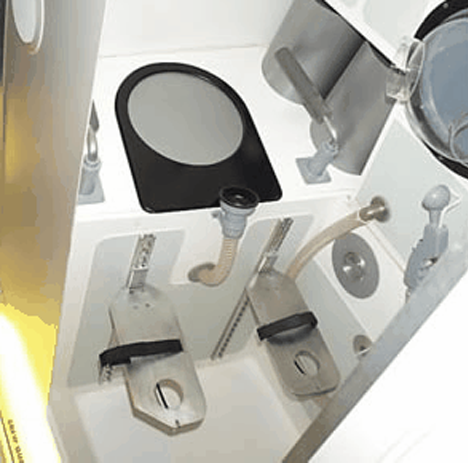
  • For the first ten years there was only one toilet on the ISS, in the Russian-built Zvezda module. 
  • In May 2008 the toilet broke and a new pump had to be rushed from Russia to America, then delivered by space shuttle. This took two long weeks. While the toilet was out of action the crew used facilities in the Soyuz transport capsule.
  • A second toilet, costing US $ 9 million, was installed in the American side of the ISS in November 2008. It is considered as the most expensive toilet in the Universe.
  • Leg and thigh restraints keep the astronaut in position as fans suck waste away. Urine is collected through hoses attached to personalized funnels.


DOUBLE RAINBOW


A RAINBOW is "one of the most spectacular light shows observed on earth". Indeed the traditional rainbow is sunlight spread out into its spectrum of colors and diverted to the eye of the observer by water droplets. The "bow" part of the word describes the fact that the rainbow is a group of nearly circular arcs of color all having a common center. It is not uncommon to see a rainbow behind or ahead of a rain storm, but have you ever seen a double rainbow?

DOUBLE-RAINBOW: According to meteorologists, a ray of sunlight passes through a raindrop, reflecting off the back of the drop at varying angles. Along with this reflection is refraction of light that causes of a spectrum of colors-- red, orange, yellow, green, blue, indigo and violet. Certain angles and "bending" reflect light better for refraction to occur, and the amount of light refraction corresponds to wavelength and color.
For example, blue light is always refracted at a deeper angle than red light. This is the reason blue is found at the inside of the bow and red on the very outside. Nature's natural color spectrum always elicits the same pattern (red, orange, yellow, green, blue, indigo, violet) when light is refracted, commonly known from the Roy G. Biv mnemonic.
While a primary rainbow is visible when light is reflected once off the back of a raindrop, a secondary and usually dimmer rainbow is spotted when light is reflected twice in a more complicated pattern. The colors of the second rainbow are inverted, with blue on the outside and red moved to the inside. The second bow appears dimmer or cloudier because much more light is released from two reflections, and both bows cover a larger portion of the sky.
It is rare and unlikely, but three or even four rainbows can be seen on occasion, but only if they are reflected off of the earthly objects. The best time to see a rainbow is in the early morning or late afternoon, when the sun is lower in the sky. When the sun is in a lower position, a higher bow can be seen. Rainbows are actually a full circle, but we only see the top bow because the bottom half is below the ground. Many rain droplets of all different sizes, not just one, are responsible for  this phenomena. Perhaps billions of water droplets and sunlight reflections make a rainbow visible to the human eye.

HOW ARE THE COLOR OF THE RAINBOW FORMED:
 The traditional description of the rainbow is that it is made up of seven colors - red, orange, yellow, green, blue, indigo, and violet. Actually, the rainbow is a whole continuum of colors from red to violet and even beyond the colors that the eye can see.

The colors of the rainbow arise from two basic facts:

1.       Sunlight is made up of the whole range of colors that the eye can detect. The range of sunlight colors, when combined, looks white to the eye. This property of sunlight was first demonstrated by Sir Isaac Newton in 1666.
2.       Light of different colors is refracted by different amounts when it passes from one medium (air, for example) into another (water or glass, for example).

NIBIRU - THE 12th PLANET DETECTED


NIBIRU - THE SECOND SUN :
The information on NIBIRU – THE SECOND SUN is more mysterious than its own origins. Not too many people know the true details of Nibiru, and why it exists in our solar system. Planet Nibiru, which was referred by the Sumerians as Planet X, was supposedly the 12th planet in our solar system. The true meaning of planet Nibiru is 'Planet of Crossing'. The planet took around 750,000 years to come between Mars and Jupiter, and when it did, it created devastation on all the planets during its flyby. Archaeologist Zecharia Sitchin and Burak Eldem also suggested this planet, which looks a lot like CR 105, with the similar orbit. According to historians, Tiamat, a planet which had lain between Mars and Jupiter around 510,000,000 million years ago, was a victim of Planet X, as Tiamat collided with one of the moon's of Nibiru; it crashed, broke into half, as one half became the asteroid belt, and the other Phobos: Mars moon, while the other half is our home, planet earth.

     "Out of destruction comes life", a quote from Hindu ancient text 'BHAGVAT GITA'.This strange planet has known to be twenty times bigger than Jupiter, with a burning moon which acts like Nibiru's personal sun. Since Nibiru goes much, much further away from our sun; this theory actually does make sense, and stands out. The Anunnaki who are supposedly the citizens of Nibiru, came to planet earth around 25,000 years ago, and gave a lot of knowledge and detail to the developing humanoids; whom at that time didn’t have the brain capacity or thinking power to comprehend what the Anunnaki were saying. Even the Mayan predicted the existence of Nibiru, or according to them, a certain dark energy in shape of a planet which would be coming near earth in the distant future.

     Every time this planet came around, entire civilization from planet earth were wiped out. James McCaney, an expert on Planet Nibiru and Mayan history explained, around 10,000 years ago major devastation occurred which destroyed many civilization on our planet. He also explained how ruined cities in South America were vanished not because of war or plague, but major physical distruction on earth. He also went on to say that before Nibiru passed us by 10,000 years ago, the North Pole was somewhere in the state of Wisconsin, while South Pole was somewhere in Pacific Ocean.

     If he is right, and this event did occur because of Planet X or Planet Nibiru, then we shouldn’t worry about it for next 740,000 years or so, right? Wrong, remember, even if Nibiru crossed its path from between Jupiter and Mars, it’s now surging upwards to make its longest route around the sun. This is due to the fact that its elliptical orbit goes in a roundabout very close to the sun on one end, while 80% of orbit is far away from the sun. This is why the earthquake that are happening in Japan, Chile and other places, could be due to the fact that magnetic pull from Nibiru is increasing as it nears our plain. The pull from Nibiru will increase gravitational force of each planet in a rubber band effect. Most of this informaiton is not provided in Wikipedia. As far as the Mayan 2012 dooms day theory is concerned, Nibiru will not be showing up this fast, because even though the earthquakes are happing and floods are taking place; like the one in Japan recently, it is still a good 10 years away where a naked eye can detect it.


     We, as a common man, could be in the dark by the big government and NASA, while Mars might be going through some devastating effect on its surface, or planet Mercury and Venus are having major, major earthquakes. One of the daily newspapers and Washington Post back in Dec 30th 1983 also picked up the report about a ‘Mystery Heavenly Body Being Discovery’, as their headline, after which they soon released another article saying it was a mistake. Of course it was a mistake; because ‘They’ do not want you do know it exists.

10 OUTRAGEOUS THINGS IN EVERY HUMAN BODY

There are all kinds of gross things in your body right now, maybe even hard lumps of calcium oxalate (kidney stone). You're making sweat, and eye gunk, and pus, and you also have undigested and partially-digested food traveling through your gut. And did you know there's more bacteria living in your body than there are human cells?

1. ACID:
THIS CLOSE UP VIEW OF STOMACH LINING SHOWS
 SMALL INDENTS KNOWN AS GASTRIC PITS, 
IN WHICH THE CELLS THAT RELEASE HYDROCHLORIC
 ACID, ENZYMES AND MUCUS RESIDE.

Your digestive system is saturated with gastric juices that are key to digesting the foods you eat, and when hydrogen combines with chloride inside your stomach it creates hydrochloric acid (HCL), that's the same hydrochloric acid used in fertilizers, dyes and, as it turns out, in the fracking process.
If the acid in your stomach is strong enough to dissolve metal, which it is, why doesn't your stomach digest itself? You can thank mucus for that. Mucus coats the lining of your stomach, protecting it from being broken down along with everything in your stomach.


2. BODY EXCRETIONS:
When you eat and drink, your body only needs a few hours to extract the vitamins and nutrients it needs from that food, and the leftovers are off to be excreted.  Your stool is made up of undigested food, but that's not all; there's also mucus, bacteria, and dead cells in there -- and it's the combination of all these ingredients that make poop brown. A normal bowel movement is mostly water, though (about 75 percent of it), and most of us get rid of about 3 to 8 ounces of waste every.

3.TONSIL STONES:
Tonsil stones, sometimes known as tonsilloliths, aren't food from last night's take-out; they're actually a combination of bacteria, dead cells and mucus that have gotten trapped in the pockets of your tonsils. If you suffer from chronic tonsillitis, then you have an increased chance of having tonsil stones. When the debris hardens, it looks like small white lumps of cauliflower in the back of your throat, including sore throat, swollen tonsils and ear pain.

4. GAS:
Everyone farts and everyone burps; there's no way around it. If you eat, you produce gas as the bacteria in your digestive system break down those foods. On average, you're passing gas anywhere between 14 to 23 times a day.The gas producing those farts and burps contains carbon dioxide, oxygen, nitrogen, hydrogen, and sometimes methane -- and sometimes sulfur. Certain foods cause your body to produce more gas, and those include high-fiber and sugary foods, beans and broccoli and products wheat or dairy, because they cannot be digested properly by them. Often the cause, is nothing more than swallowed air.

5. VOMIT:
The average stomach will hold about three-quarters of a gallon (that's 1 liter) of chewed food and beverages. If your stomach and intestines decide to close the gate on what you've eaten, that food and drink won't pass normally through to your bowel. Instead, it's coming back up, and sometimes forcefully. Vomiting is actually controlled by a "vomiting center" in the brain, and can be caused by a number of things, including food-borne illness, infections, some illnesses and pregnancy, as well as side effects of some medications or certain medical treatments.

6.BACTERIA :
A healthy human body is actually less human than you might think; as an adult, your body is hosting at least 10 times as many microbial cells (that's bacteria, viruses and other types of microbes) as you have human cells -- probably about 100 trillion bacteria in all. living in every luke and corner of your body.
FUNCTION: Fewer than 1 percent of the bacteria in the human body can cause disease, and others work with the body to help it do things it may not have been able to do on its own -- for instance, Lactobacillus acidophilus, a popular active culture in yogurt, helps the body digest food and fight against that 1 percent of ill-willed microbes.


7. MUCUSPALOOZA:
Boogers, Snot,  Phlegm -  Whatever you call it, there's a good reason it exists: mucus. Mucus is a stringy, sticky fluid that coats the inside of your nose, mouth, sinuses, throat, lungs and gastrointestinal tract -- and it's there all the time, not only when you have a cold. In fact, your body makes between about one-quarter to half a gallon (1 to 1.5 liters, roughly) of mucus every day; and that includes the new batch your nose whips up every 20 minutes.
FUNCTION: Mucus acts as a lubricant -- and without it, body tissues would dry out -- and because it's sticky, it also acts as a trash collector, keeping bacteria and debris (such as pollen, dirt, fungi, smoke or whatever else you might breathe in) from invading your body as you breathe.

8. FATTY DEPOSITS (LIPOMA):
Fatty deposits are small, round masses of fat cells below your skin, between your skin and muscle. Our body maintains an energy reserve in its fat cells as a part of normal operating procedure, but sometimes fat cells grow where they shouldn't. This results in fatty deposits, also called lipomas, and although some may find them gross, they're almost always harmless.

9. EAR WAX:
Ear wax, which is also known as cerumen, is an oily, waxy substance produced by the glands inside your ear canal. . North Americans spend more than $60 million annually on at-home ear-cleaning products, and about 12 million Americans go one more step to have their ear wax professionally removed by a doctor every.
FUNCTION: It's a way for the ear to protect itself; wax stops intruders from getting into your ear, including dust and bugs (it's been known to happen), among other debris. Ear wax also helps lubricate the ear, protect your ear canal from irritation, and has antibacterial properties.

10. EYELASH MITES:
There are mites living in your eyelashes; and the older you are and the more oily your skin, the more likely that statement is true. It's estimated that mites, specifically Demodex mites (D. folliculorum, to be exact), have colonized the eyelashes of more than 80 percent of people over the age of 60. In fact, you can find as many as 25 mites living a single eyelash follicle. Though these follicle squatters are alarming, they're mostly harmless.