Showing posts with label NATURE. Show all posts

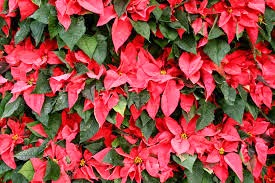
POINSETTIA – THE CHRISTMAS FLOWER:


Kingdom: Plantae
Division  : Magnoliophyta
Class      : Magnoliopsida
Order     : Malpighiales
Family    : Euphorbiaceae
Genus     : Euphorbia
Species   :pulcherrima

      Poinsettias are a well-loved variety of houseplant and are popular potted plants, particularly during the Christmas season. The brightly colored red and green leaves flourish in foil-covered pots in public places enhancing the holiday spirit and hold the Christmas charm. They are said to be poisonous and to have been originated in Mexican state of Morelos.
     The bright petals of Poinsettias are actually the bunch of upper leaves of the plant, called bracts. The flower as such is very small, blooming in the center of each leaf bunch. The plant is a sub-tropical one and it cannot stand night temperatures below 100 C and an excess of 210 C in day time. In colder climates they have to be grown as indoor plants. They seem to need an uninterrupted long, light-free nights for about two months in spring to develop flowers.

SOME INTERESTING FACTS ABOUT POINSETTIA:
  • ·         Poinsettia also blooms in cream, lemon, peach, pink colors and with white and gold splashed leaves.
  • ·         Its botanical name “Euphorbia pulcherrima” means – the most beautiful Euphorbia.
  • ·         It is actually a tropical tree which can grow to a height of 12 feet.
  • ·         It was named after the former US ambassador to Mexico, Dr. Joel R. Poinsett who introduced the Poinsettia to the United States.
  • ·         The plant grows to height of 16 feet.
  • ·         They are also called – “Lobster flower”, “Mexican flame leaf” and “Christmas flower”.
  • ·         December 12th is celebrated as National Poinsettia Day, in memory of Joel R. Poinsett.
  • ·         It was a symbol of Purity to the ancient Aztecs civilization.
  • ·         There are more than 100 varieties of poinsettias coming in different colors.
  • ·         It is a native of southern Mexico, blooming in the month of December this flower is used to decorate churches for many centuries.
  • ·         According to USDA Floriculture’s Statistical records for the year 2013, nearly 34 million poinsettias have been sold accounting to 23 % of total sales of all flowering plants.
  • ·         California is the topper in the cultivation of Poinsettias with over 6 million pots grown, followed by North Carolina with 4.4 pots sold and then comes Texas with 3.7 million cultivated every year.
  • ·         It is said that the Aztecs used the leaves of this flowering plant to dye fabrics and its sap was used for medicinal purposes.
  • ·         In Mexican and Guatemala language Poinsettia is called as “The Flower of the Holy Night” with reference to Christmas Eve.
  • ·         This plant was introduced into United States by Dr. Joel Roberts Poinsett, a botanist and first ambassador of USA to Mexico. He was attracted to the flowers brilliantly colored red leaves found on the side of the road to Taxco, Mexico in December 1828.
  • ·         USA celebrates December 12th as National Poinsettia Day in remembrance of the man who introduced the flower to the nation.
  •   This plant was once identified as poisonous but now many researchers have proved this wrong however it might cause stomach irritation and discomfort when eaten.
           

TOP 10 NATURAL WORLD WONDERS

1. Darvaza Gas Crater, Turkmenistan:
Popularly known as the “The Door to Hell,” this burning crater is a 196 feet wide and 65 feet deep hole in the Karakum desert in Turkmenistan. It has been burning for the past 38 years. It is not of natural occurrence, but by the exploration accident of a Soviet company. The geologists decided to burn away the poisonous gas to protect the local people.
2. Jeita Grotto, Nahr al-Kalb Valley, Lebanon:
These two caves together make up the longest explored cave in Lebanon. Found in the outskirts of Beirut, these caves attract thousands of visitors for it stalactites formed in different colors. The world’s largest stalactite (26.9 ft.) is found in these caves.


3. Mount Roraima, Guyana/Brazil/Venezuela:
Stretching along the borders of Venezuela, Brazil and Guyana is found the massive sandstone plateau. It is surrounded by 1300 ft cliffs, which creates an isolated and unique ecosystem. There are huge crystal formations on the floor and amazing rock formations carved by wind and water on the top of the plateau

4. Belize Barrier Reef, Belize City:
Being one of the largest barrier reefs in the world, it is also known as “The Great Blue Hole.”  It has atolls, hundreds of cays, mangrove forests, coastal lagoons and estuaries. It is so big that much of it still stays undiscovered and only 10% of its marine life has been identified. It is very famous for its clear and warm protected water which is very apt for snorkelers and novice divers.

5. Eye of the Sahara, Mauritania, Sahara Desert:
Found in the surreal landscape Mauritania, in the Sahara Desert, this mysterious Eye of the Sahara is also known as the Richat Structure. This circular structure was once thought to be a crater, but now it has been determined to be an outcome of erosion. With almost 25 miles diameter, it looks like a gigantic bulls eye from space.

6. Valley of the Moon, San Juan, Argentina:
This Ischigualasto Formation, popularly known as the Valley of the Moon, is filled with strange clay formations of different shapes and colors, which were created by deposition of minerals and sediments. It houses dinosaur fossils dating back to 225 million years ago, and has all the dinosaur fossils from the Triassic period.

7. Ngorogoro Crater, Tanzania: 
This crater is such a beautiful natural wonder because; it is a deep, volcanic crater that is the largest unflooded and unbroken caldera in the world. It was created by a volcanic eruption 2-3 million years ago. It is 13 miles across and 2000 ft deep. Today it houses nearly 25,000 wild animals. There are many resorts around the crater. This attracts many visitors to see the animals in their natural habitat.

8. Blue Grotto, Capri, Italy:
This is a sea cave made of limestone on the coast of the island of Capri. The water inside the cave has a brilliant sapphire blue color. This is because of the light entering this cave through another one which reflects off the whit floor of the water. This creates an magical environment which was once a bathing spot for emperors.

9. The Shilin Stone Forest, China:
Found in the Yunnan province, the Shilin Forest spreads over 135 square miles looking like an ancient petrified forest filled with rock formations that jut vertically from the ground. It is suggested to have been formed 270 million years ago. It was formed when a large sea covering the area was made to retreat due to the constant movement of the earth, allowing the limestone cliffs to rise.


10. Slot Canyons, Arizona and Utah: 
The Slot Canyons are very deep canyons, with very unique shapes, formed when water was rushed through sandstone and limestone. They are found in Arizona and Utah. Situated just outside Glen Canyon National Recreation Area is the most visited Antelope Canyon, just outside slot canyon in the Southwest.

CORAL REEF - A BRIEF NOTE

What is a coral reef?

     The coral community is really a system that includes a collection of biological communities, representing one of the most diverse ecosystems in the world. For this reason, coral reefs often are referred to as the "rain-forests of the oceans."It is an animal, vegetable and mineral! A coral reef is a colony of millions of tiny animals called POLYPS. As they grow, each polyp produces a hard, limestone skeleton, on which the next generation of polyps grow.Corals also contain an algae, which is essential for their survival.

What is a polyp made up of?

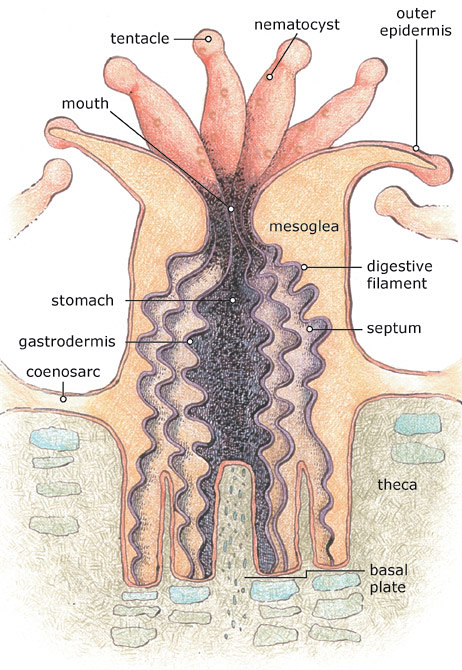
     The corals polyps are tiny invertebrate animals belonging to the group CNIDARIA. They belong to the jellyfish and anemone family. Their size ranges from a tiny pin head size to that of a foot. They are sessile, and feed using their tentacles tentacles to catch prey such as small fish and planktonic animals. One coral branch or mound is covered by thousands of coral polyps, which are grouped together to form a coral colony.
     A polyp has a saclike body and an opening, or mouth, encircled by stinging tentacles called cnidae. The polyp uses calcium carbonate (limestone) from seawater to build itself a hard, cup-shaped skeleton. This protects the soft, delicate body of the polyp and the calcium carbonate is continuously deposited by the living colony, adding to the size of the structure.

Why do we need coral reefs?

  • Although coral reefs cover less than 1% of the Earth's surface,they are home to 25% of all marine fish species.
  • Reef fish and molluscs feed between 30 and 40 million people every year. An estimated 500 million people rely on coral reefs for their food or livelihoods.
  • Chemical compounds found in reefs are used to make several important medicines.
  • Coral polyps turn the carbon dioxide in water into limestone. Without coral, the amount of carbon dioxide in the ware would rise, destroying precious habitats.
  • Coral reefs form natural barriers that protect nearby shoreline from strong waves or currents.

When was the Coral reef formed?

  • The world's first coral reefs appear around 500 million years ago.
  • Modern corals first develop in the Early Triassic era, 230 million years ago.
  • Mass extinction of the coral reefs happened around 199 million years ago,when 2/3ds of them were wiped away by climatic changes, at the end of the Triassic era.
  • 18 million years ago the formation of Australia's Great Barrier Reef began. Its growth had started and stopped many times since then.
  • Around 18,000 years ago, the temperature of the Earth fell and sea water became trapped as ice in enormous glaciers, causing sea levels to fall to their lowest levels ever. So if at all there were any corals they would have been exposed and died during this period.
  • The reefs which we see today would have started to grow around 10,000 - 8,000 years ago. It was at the end of this last ice age that they began to develop. The glaciers melted and sea levels rose to the position that we still see today.

 Different kinds of corals:

There are two main types of corals - hard,stony corals that build reefs and the soft corals that dont. They often have very descriptive names. 
  • BRAIN CORAL :- The wrinkled ridges of this hard coral make it look like a giant brain.
  • FAN CORAL:- The polyps of fan coral link together to form a large lacy skeleton.
  • DEAD-MAN'S-FINGERS :- The tentacles of these polyps look like decomposing fingers.
  • STAGHORN CORAL :- This antler-like coral is one of the speediest growers on the reef.

Different kinds of coral reefs:

  • FRINGING REEFS :- These reefs follow the shorelines of continents and islands in tropical sea, and are found close to shore. This is the most common type of coral reef and it is found in the Caribbean and Red Sea.
  • BARRIER REEFS :- Lying further offshore, barrier reefs are separated from land by a deep lagoon. Most famous of it is the Great Barrier Reef in Australia.
  • ATOLL REEFS :- A ring of coral that grows on top of a sunken volcano, forming a lagoon, is called an atoll. Mostly they are found in the Pacific Ocean and Indian Ocean.
  • PATCH REEFS :- Patches of young coral commonly grow at the bottom of the sea in the lagoon behind a barrier or atoll reef.
  • PLATFORM REEFS :- When coral reaches the surface of the sea and branches out, growing horizontally, a platform reef is formed. eg. Torres Strait.

Greatest reefs of the world:

    GREAT BARRIER REEF
  • THE GREAT BARRIER REEF, AUSTRALIA: About 3,000 reefs combine to form the largest living structure on Earth, more than 2,010 km (1,250 miles) long. It is the home to 500 species of corals, 400 species of seaweed, 1,000 species of sea sponge, 174 species of bird, 1,500 species of fish, 30 species of mammal.
  • KWAJALEIN, MARSHALL ISLAND : The world's largest atoll surrounds a lagoon 97 km (60 miles) long.
  • BIKINI ISLAND, SOUTH PACIFIC
  • LIGHTHOUSE REEF, BELIZE : At the centre of this Caribbean atoll lies the Great Blue Hole, 145 m deep.


FOSSIL FUELS - IMPORTANCE AND CONSEVATION


WHAT ARE FOSSIL FUELS?


Fossil fuels are hydrocarbons, primarily coal, fuel oil or natural gas, formed from the remains of dead plants and animals. Fossil fuels are fuels formed by natural processes such as anaerobic decomposition of buried dead organisms . The age of the organisms and their resulting fossil fuels is typically millions of years, and sometimes exceeds 650 million years. It also includes hydrocarbon-containing natural resources that are not derived from animal or plant sources. These are sometimes known instead as mineral fuels. A small portion of hydrocarbon-based fuels are biofuels derived from atmospheric carbon dioxide, and thus do not increase the net amount of carbon dioxide in the atmosphere.


ORIGIN:


Fossil fuel is a general term for buried combustible geologic deposits of organic materials, formed from decayed plants and animals that have been converted to crude oil, coal, natural gas, or heavy oils by exposure to heat and pressure in the earth's crust over hundreds of millions of years.

Petroleum and natural gas are formed by the anaerobic decomposition of remains of organisms including phytoplankton and zooplankton that settled to the sea (or lake) bottom in large quantities under anoxic conditions, millions of years ago. Over geological time, this organic matter, mixed with mud, got buried under heavy layers of sediment. The resulting high levels of heat and pressure caused the organic matter to chemically alter, first into a waxy material known as kerogen which is found in oil shales, and then with more heat into liquid and gaseous hydrocarbons in a process known as catagenesis.

Terrestrial plants, on the other hand, tend to form coal and methane. Many of the coal fields date to the Carboniferous period of Earth's history. Terrestrial plants also form type III kerogen, a source of natural gas.


COMPOSITION OF FOSSIL FUELS:


Fossil fuels contain high percentages of carbon and include coal, petroleum, and natural gas. They range from volatile materials with low carbon:hydrogen ratios like methane, to liquid petroleum to nonvolatile materials composed of almost pure carbon, like anthracite coal. Methane can be found in hydrocarbon fields, alone, associated with oil, or in the form of methane clathrates. The theory that fossil fuels formed from the fossilized remains of dead plants by exposure to heat and pressure in the Earth's crust over millions of years, was first introduced by Georg Agricola in 1556 and later by Mikhail Lomonosov in the 18th century.

(The Energy Information Administration estimates that in 2007 the primary sources of energy consisted of petroleum 36.0%, coal 27.4%, natural gas 23.0%, amounting to an 86.4% share for fossil fuels in primary energy consumption in the world. Non-fossil sources in 2006 included hydroelectric 6.3%, nuclear 8.5%, and others (geothermal, solar, tidal, wind, wood, waste) amounting to 0.9%.[6] World energy consumption was growing about 2.3% per year.)


USES OF FOSSIL FUEL:


Fossil fuels are non-renewable energy sources that formed more than 300 million years ago during the Carboniferous Period - long before dinosaurs roamed the Earth. Fossil fuels are made up of plant and animal matter. When plants and animals died, their bodies decomposed and were buried under layers of earth. Millions of years later we have the three forms of fossil fuel: oil, natural gas and coal.


1.FOSSIL FUEL ENERGY - OIL


Oil is a thick, black, gooey liquid also called petroleum. It's found way down in the ground, usually between layers of rock. To get oil out, a well is dug. Digging a well is like putting a straw into a can of pop. The oil is then pumped out of the ground, just like when you suck pop up the straw. Oil is carried in pipelines and large tanker ships. A refinery changes the oil into products like gasoline, jet fuel and diesel fuel. It's also burned in factories and power plants to make electricity. The oil is burned, which produces gases that turn a turbine to create electricity.


2.FOSSIL FUEL ENERGY - NATURAL GAS


Natural gas is lighter than air. Natural gas is made out of methane, which is a simple chemical compound made up of carbon and hydrogen atoms. This gas is highly flammable, so no farting near it. Natural gas is found near oil in the ground. It's pumped, just like oil, from wells that tap into the source and send it to large pipelines. Because you can't smell or see natural gas, it is mixed with a chemical to give it a stinky smell - like rotten eggs. That way, it's easy to tell if there's a leak.


After the stinky chemical is added, the natural gas is sent through underground pipes which go to your home so you can cook food and heat your house. It's also sent to factories and power plants to make electricity. Natural gas is burned to produce heat, which boils water, creating steam, which passes through a turbine to generate electricity.


3.FOSSIL FUEL ENERGY - COAL


Coal comes in several different forms from hard black rocks (that's the kind you get in your stocking at Christmas) to soft brown dirt. Some forms burn hotter and cleaner than others. Coal is used to create more than half of all the electricity made in the US. In the states, many of the coal beds are near the ground's surface. We get to the coal by mining for it. Most coal is transported by trains to power plants where it's burned to make steam. The steam turns turbines, which produce electricity.


WHY MUST WE CONSERVE FOSSIL FUELS?


Fossil fuels are one of the greatest threats to the environment today. Their burning contributes heavily to global warming, the pollution of the air, water and land, as well as the production of acid rain. Fossil fuels are non-renewable resources because they take millions of years to form, and reserves are being depleted much faster than new ones are being made. The production and use of fossil fuels raise environmental concerns. A global movement towards the generation of renewable energy is therefore under way to help meet increased energy needs.


When fossil fuels are burned huge amounts of carbon are released into the air. This contributes to the greenhouse effect, causing the sun’s warmth to be excessively trapped in the atmosphere. When this occurs, global temperatures rise. Melting of the polar ice caps causes ocean levels to rise as well.

(The burning of fossil fuels produces around 21.3 billion tonnes (21.3 gigatonnes) of carbon dioxide (CO2) per year, but it is estimated that natural processes can only absorb about half of that amount, so there is a net increase of 10.65 billion tonnes of atmospheric carbon dioxide per year (one tonne of atmospheric carbon is equivalent to 44/12 or 3.7 tonnes of carbon dioxide). Carbon dioxide is one of the greenhouse gases that enhances radiative forcing and contributes to global warming, causing the average surface temperature of the Earth to rise in response, which the vast majority of climate scientists agree will cause major adverse effects.)


This reduces the salinity of the ocean, endangering many organisms that are dependent upon a certain level of salt concentration to be able to live. It also poses a serious risk of many cities and settlements located close to sea level entirely disappearing under water.


HOW TO CONSERVE FOSSIL FUELS:


Fossil fuels are materials that are non-renewable such as oil and coal. These have a big effect on the earth's ozone layer which keeps ultra-violet rays out. This will show you how to do your part in conserving fossil fuels.

1. Ride a bike. Instead of driving a car or taking a bus, try cycling or walking to your destination. This is better for the environment and better for you.

2. Buy solar panels. These are expensive but use solar power to heat your home, unlike heaters they don't use fossil fuels for heat.

3. Try not to use too much plastic. Fact: most of the plastic bags used today are made of oil. If there is no other alternative then just recycle them when done. Plastic bags can be reused at a grocery store if you ask to use the same bags. Some stores offer reusable bags too.

4. Reduce, Reuse, Recycle. Making new cans and bottles take a whole lot more fossil fuels than recycling an old one. In most cities, recycling plants will pay money for cans. Be sure to meet that recycling centers requirements. For example, most recycling plants want the lids taken off of bottles. Also know what you can, and cannot recycle.

5. Turn off lights. Several million people leave there lights on when going on vacation, business trips, etc, without even knowing it. This harms the environment and costs them a lot of money.

6. Influence others. Start a campaign that helps the environment such as litter clean up or picking up cans. Ask local leaders if you can put signs on posts where heavy traffic is.


MOST WEIRDEST MAMMALS NAMED AS EXTINCT

14 RAREST AND WEIRDEST MAMMAL SPECIES NAMED:-


1-3:-EASTERN LONG-BEAKED ECHIDNA

In the picture, Scientist Kris Helgen holds an EASTERN LONG-BEAKED ECHIDNA in Indonesia's Foja Mountains. The elusive egg-laying species is one of the rarest and most genetically unique mammals on the planet, according to the Zoological Society of London's 2010 EDGE (Evolutionarily Distinct, Globally Endangered) list, released November 19.


4. GREATER SHORT-TAILED BAT:-

The GREATER SHORT-TAILED BAT  (shown in an illustration) is likely totally gone from its native islands off New Zealand. The ground-dwelling bat is defenseless against voracious, introduced rats and has not been seen since 1967.


5. BAIJI:-


China's baiji, or Yangtze River dolphin, may already be extinct—just 13 were found during a population survey between 1997 and 1999. Baiji are often caught in nets, struck by boats, or killed by pollution in the industry-choked Yangtze. Authorities have placed restrictions on fishing and dumping in the river, according to ZSL, but those restrictions are widely ignored.


6. MOUNTAIN PYGMY POSSUM:-


Ski resorts in southeastern Australia have caused the decline of the mountain pygmy possum, according to EDGE experts.That's because grooming snow on ski slopes can disturb the snow-hibernating creatures or destroy their habitat. Thought to be extinct until one was found inside a ski chalet in 1966, the possum's range is now confined to just a few square kilometers.


7-8. HISPANIOLAN AND CUBAN SOLENODONS:-


This may look like a rodent of unusual size, but the rare Hispaniolan solenodon (pictured in 2009) isn't a rodent at all. More closely related to shrews and moles, the solenodons are the only mammals that inject prey with venom, through special grooves in their teeth. There are only two species: the Hispaniolan solenodon—native to the island of Hispaniola, shared by Haiti and the Dominican Republic—and the Cuban solenodon, which was rediscovered in 2003.

9. RIVERINE RABBIT:-


The riverine rabbit (pictured in a file photo) is unlike most of its kin in one crucial way: It doesn't breed like a rabbit. While many rabbit species can raise up to 12 babies per litter and bear multiple litters in a season, the riverine rabbit usually raises one kit at a time—and it lives for just three or four years in the wild. Furthermore, the animal is very dependent on the thick vegetation and soft soil found only along riverbanks in South Africa's Karoo Desert.


10-11: SUMATRAN AND BLACK RHINOCEROS:-


The fast decline of Southeast Asia's Sumatran rhinoceros (pictured, a mother and her calf at the Cincinnati Zoo) and the black rhinoceroses of central and southern Africa have landed the species near the top of the EGDE list. All rhinoceros species are considered to be threatened or vulnerable by IUCN due mostly to poaching, which has doubled in the past year. Compounding the issue, rhinoceroses prefer different breeding environments than many mammals.


12. NORTHERN HAIRY-NOSED WOMBAT:-


A northern hairy-nosed wombat peers out of a trap in Queensland, Australia, in a file picture. Only three known species of wombat exist, making the family one of the most evolutionarily unique. Unlike koalas or kangaroos, the burrowing marsupials carry their young in pouches that face backward, which keeps dirt out. (See a picture of a common wombat.)Predators introduced to Australia, such as the dingo, have nearly wiped out Earth's biggest wombat species. Today, only one colony of fewer than a hundred individuals remains—protected by a dingo-proof fence.


13. BACTRIAN CAMEL:-


The Bactrian camel (pictured, a herd in the Gobi) is distinguished from the more familiar Arabian (dromedary) camel by its two humps. The species has lost out in a competition for food and water with livestock, including its own domesticated brethren. The wild Bactrian also has unique adaptations to its extreme climate: Its coat goes from incredibly thick in winter to almost hairless in summer, and the animal has squishy foot pads—like "bags filled with slime"—that act like snowshoes, to keep it from sinking into the desert sand.


14. JAVAN RHINOCEROS:-


Considered "more primitive" than Africa's white or black rhinoceroses, the Javan rhino (shown in a file photo) is the rarest of all living rhinoceros species. Though the approximately 50 remaining Javan rhinoceroses live inside protected national parks in Vietnam and Java, Indonesia, the risk of poaching for their horns remains.